

Article Sidebar
Main Article Content
Abstract
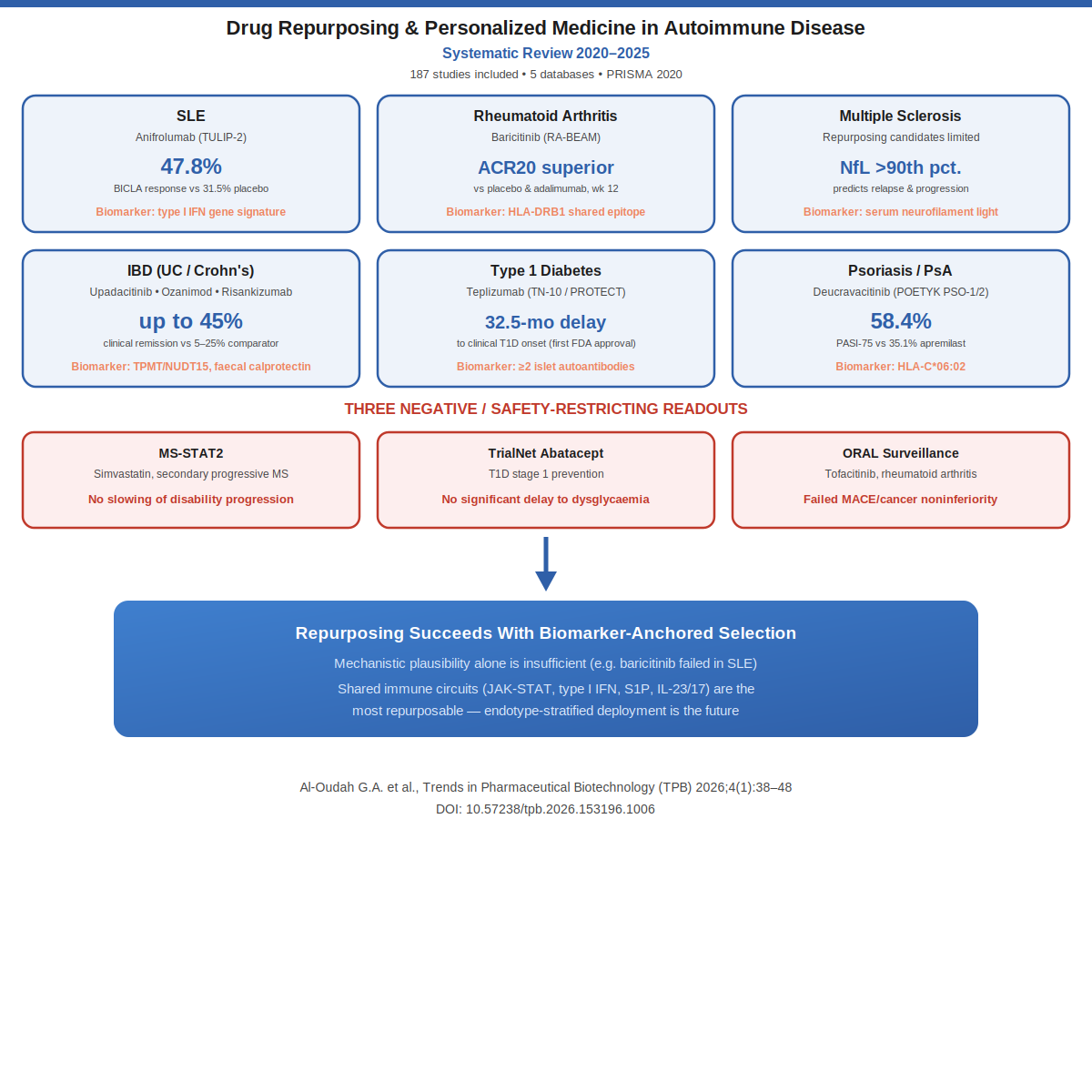
Background: Autoimmune diseases collectively affect approximately 10% of the global population and carry rising disability-adjusted life-year burdens across all age groups. De novo drug development costs approximately 2.56$ US billion per approved compound. Drug repurposing combined with precision medicine offers a faster, safer, and more cost-effective alternative. Objective: To systematically synthesize evidence (January 2020 – May 2025) on repurposed pharmacotherapies in major autoimmune diseases and the biomarker, omics, and pharmacogenomic frameworks used to personalize their deployment. Methods: Following PRISMA 2020, we searched PubMed/MEDLINE, Scopus, Web of Science, Cochrane CENTRAL, and ClinicalTrials.gov. Randomized controlled trials were appraised with Cochrane RoB 2.0; non-randomised studies with ROBINS-I. Data were synthesized narratively across six disease categories. Results: 187 studies met inclusion criteria. Five pivotal phase 3 programs delivered practice-changing results: anifr olumab (TULIP-2) in systemic lupus erythematosus, voclosporin (AURORA 1) in lupus nephritis, upadacitinib (U-ACHIEVE/U-ACCOMPLISH) in ulcerative colitis, ozanimod (True North) in ulcerative colitis, and teplizumab (PROTECT) in type 1 diabetes. Deucravacitinib (POETYK PSO-1/2) and risankizumab (ADVANCE/MOTIVATE) transformed psoriasis and Crohn's disease management respectively. Three programs delivered negative or safety-restricting outcomes: MS-STAT2 (simvastatin in secondary progressive MS), the TrialNet Abatacept Prevention Study, and ORAL Surveillance (tofacitinib cardiovascular/cancer risk). Validated personalization tools include the type I interferon gene signature for anifrolumab in SLE, serum neurofilament light chain for MS therapy escalation, TPMT/NUDT15 genotyping for thiopurines in IBD, islet autoantibody staging for teplizumab in type 1 diabetes, and HLA-C*06:02 for ustekinumab selection in psoriasis. Conclusions: Drug repurposing produced the most impactful autoimmune therapeutics of 2020–2025. Population-level approvals are giving way to biomarker-anchored, endotype-stratified deployment. Future gains require adaptive trial designs, prospective omics companion diagnostics, polygenic risk score integration, and equitable access policies.
Keywords
Article Details
Copyright (c) 2026 Ghadah Ali Al-Oudah, Nada Khazal K. Hindi *, Maytham Ahmed AbdulAemah, Dhelal Fouad Mohammed, Ahmed Baher Kamal Al-Deen, Awab Ameer Al-Ameedee (Author)

This work is licensed under a Creative Commons Attribution 4.0 International License.