

Article Sidebar
Main Article Content
Abstract
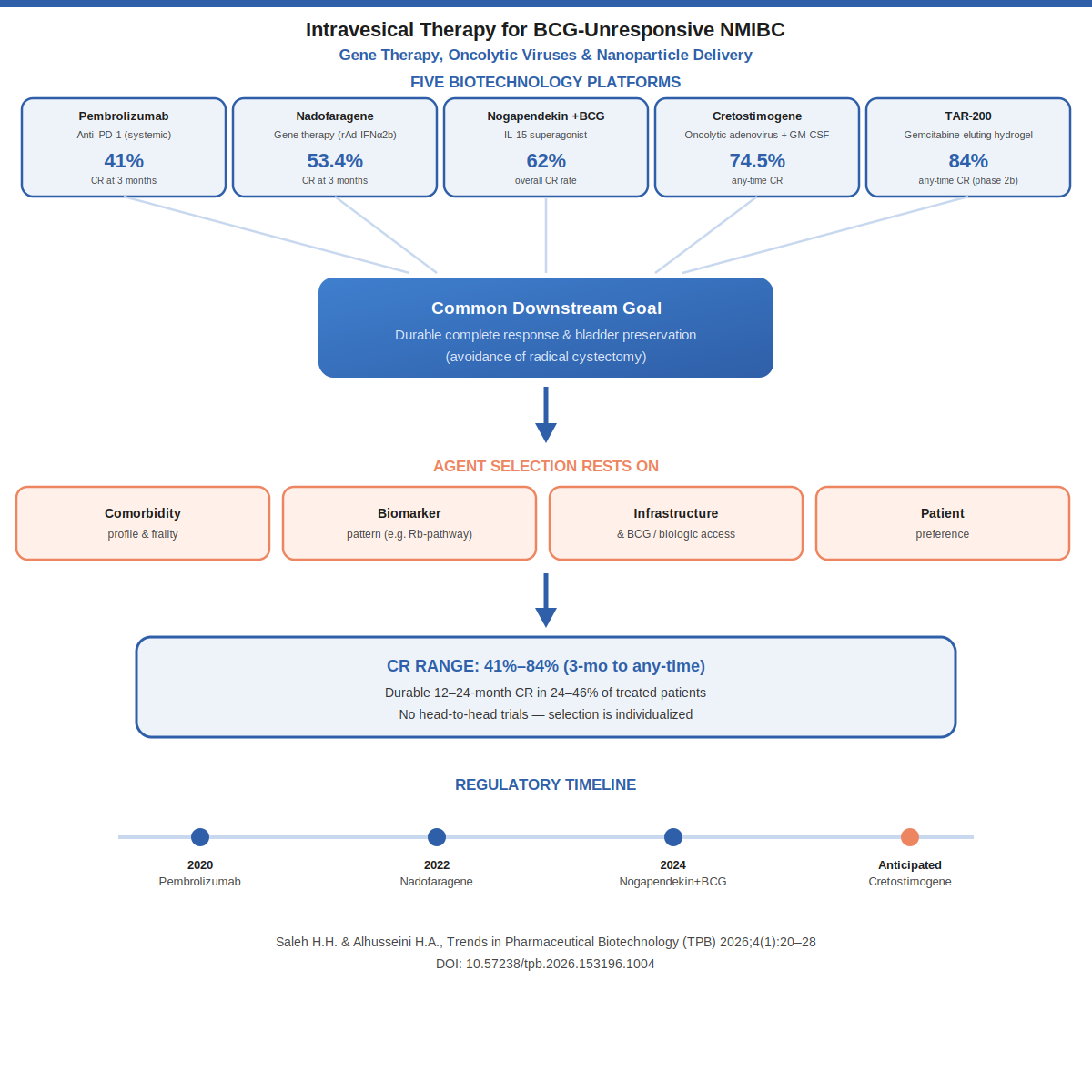
Background. Non-muscle-invasive bladder cancer (NMIBC) accounts for approximately 75% of new bladder cancer diagnoses. Bacillus Calmette–Guérin (BCG) is the established intravesical immunotherapy for high-risk disease, but 30–40% of patients become BCG-unresponsive defined by 2018 US Food and Drug Administration (FDA) criteria as recurrence of high-grade disease despite adequate BCG exposure. Radical cystectomy has long been the standard salvage option, but carries substantial morbidity and quality-of-life cost; bladder-sparing alternatives are urgently needed. The therapeutic landscape has expanded rapidly between 2020 and 2026 with the regulatory approval of pembrolizumab (2020), nadofaragene firadenovec (2022, the first intravesical gene therapy), and nogapendekin alfa inbakicept plus BCG (2024, the first interleukin-15 [IL-15] superagonist), with cretostimogene grenadenorepvec (an oncolytic adenovirus) anticipated next. Objective. This narrative evidence-based review synthesizes the 2020–2026 literature on biopharmaceutical and biotechnology-based intravesical therapy for BCG-unresponsive NMIBC, focusing on mechanism, pivotal trial evidence, safety, and patient-selection considerations from a clinical urologist's perspective. Methods. PubMed, Embase, the Cochrane Central Register of Controlled Trials, and ClinicalTrials.gov were searched from January 2020 through March 2026. Eligible publications included pivotal phase 2 or 3 trials, systematic reviews and meta-analyses, regulatory documents, evidence-based guidelines, and selected translational papers. Reporting follows narrative-review principles informed by the PRISMA 2020 statement. Results. Sixty-eight studies were included. Pembrolizumab (anti–programmed cell death protein 1 [PD-1]) achieved a 41% complete response (CR) rate at 3 months in KEYNOTE-057 cohort A; nadofaragene firadenovec (recombinant adenovirus carrying interferon-α2b [IFN-α2b] complementary DNA) achieved 53.4% CR at 3 months and 24.3% CR at 12 months in the pivotal phase 3 trial; nogapendekin alfa inbakicept plus BCG achieved 62% overall CR rate in QUILT-3.032; and cretostimogene grenadenorepvec achieved 74.5% any-time CR and 41.8% durable CR at 24 months in BOND-003. Conclusions. Five distinct biotechnology platforms are now available for BCG-unresponsive NMIBC: anti–PD-1 systemic immunotherapy, non-replicating adenoviral gene therapy, IL-15 superagonist immunotherapy, oncolytic adenovirus, and emerging nanoparticle drug-delivery systems. The clinical urologist now exercises a meaningful choice among bladder-sparing options. Head-to-head evidence remains absent; selection rests on biomarker pattern, comorbidity profile, infrastructure access, and patient preference.
Keywords
Article Details
Copyright (c) 2026 Hayder Hakim Saleh, Hasan Ali Salmam Alhusseini (Author)

This work is licensed under a Creative Commons Attribution 4.0 International License.