

Article Sidebar
Main Article Content
Abstract
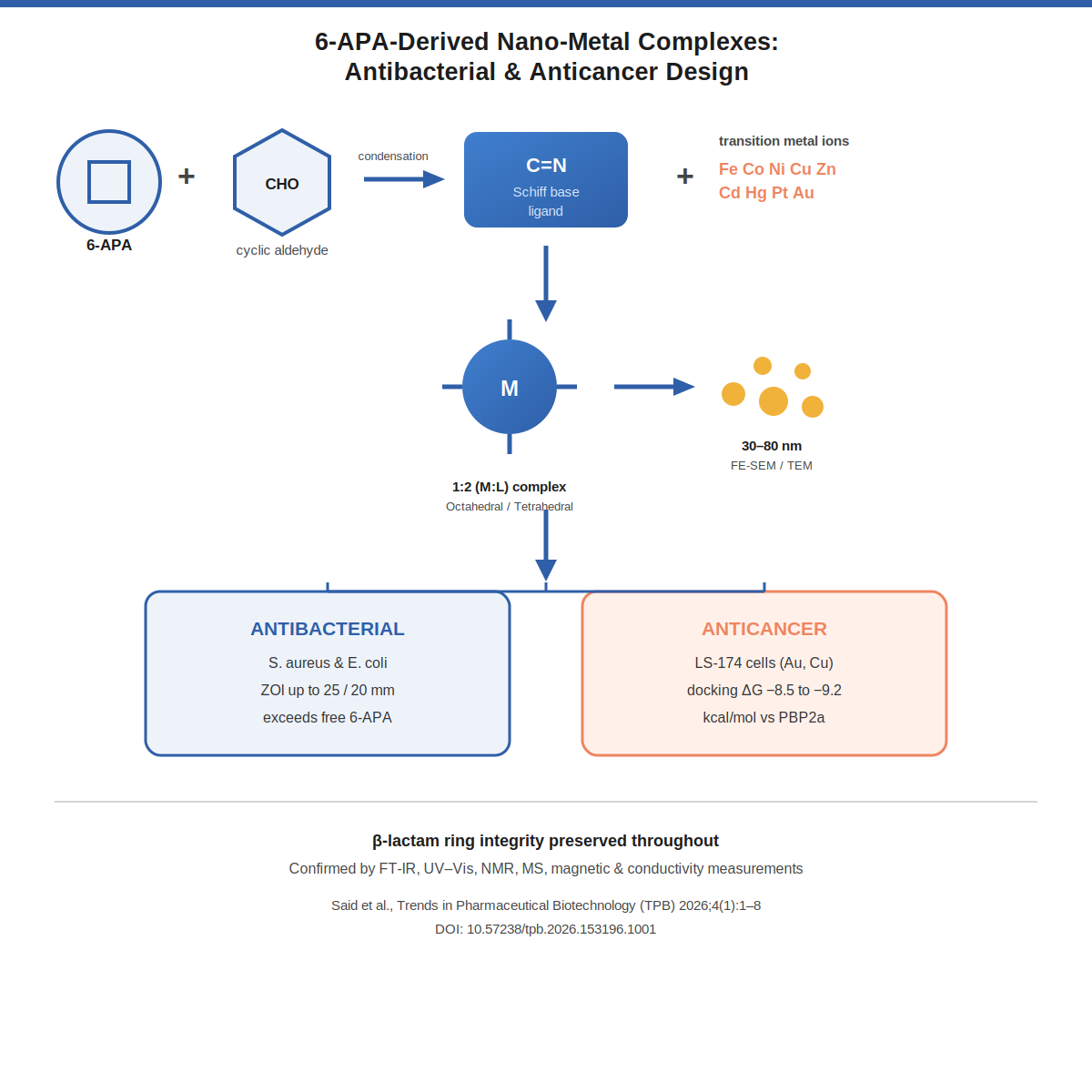
People widely use antimicrobials without medical consultation, leading to the spread of antimicrobial resistance worldwide. This means that continuous efforts must be made to develop and improve antimicrobials, especially beta-lactam inhibitors. This study explores the development of advanced metal therapies using 6-aminopenicillanic acid . Where the compound was combined with a series of different cyclic aldehydes to generate a series of bonds. Then this bond was linked with transition metal ions such as , and . Many spectroscopic analyses confirmed the successful formation of the complexes. Most often, these compounds appeared as octahydrates and had a 1:2 ratio of metal to ligand. Additional tests on the conductivity and magnetic properties of these compounds confirmed the geometric shape and physical and chemical properties while maintaining the integrity of the beta-lactam ring. Both the field emission scanning electron microscope and the transmission electron microscope showed that there are nanoparticles with sizes ranging from 30 to 80 nanometres. When metals were added to the antibiotics through compound formation, they were much more effective in killing Staphylococcus aureus and Escherichia coli in the laboratory compared to the original compound . It was found that these compounds were more effective than the more recent studies. These studies provided additional evidence that the complex compounds are more effective than the original compounds. They also discovered that it can be used to treat more than one type of cancer when they simulated molecular docking and cytotoxic activity against cancer cells. This study shows that nanometallic compounds provide a promising basis for the development of new antibiotics and anticancer drugs.
Keywords
Article Details
Copyright (c) 2026 Zaynab .F. AI-Janahi, Mohammed Hamid Said*, Tamara F. Hassen, Ghufran Kareem, Aliaa Kareem Abdulla, Ali Mohammed (Author)

This work is licensed under a Creative Commons Attribution 4.0 International License.