

Article Sidebar
Main Article Content
Abstract
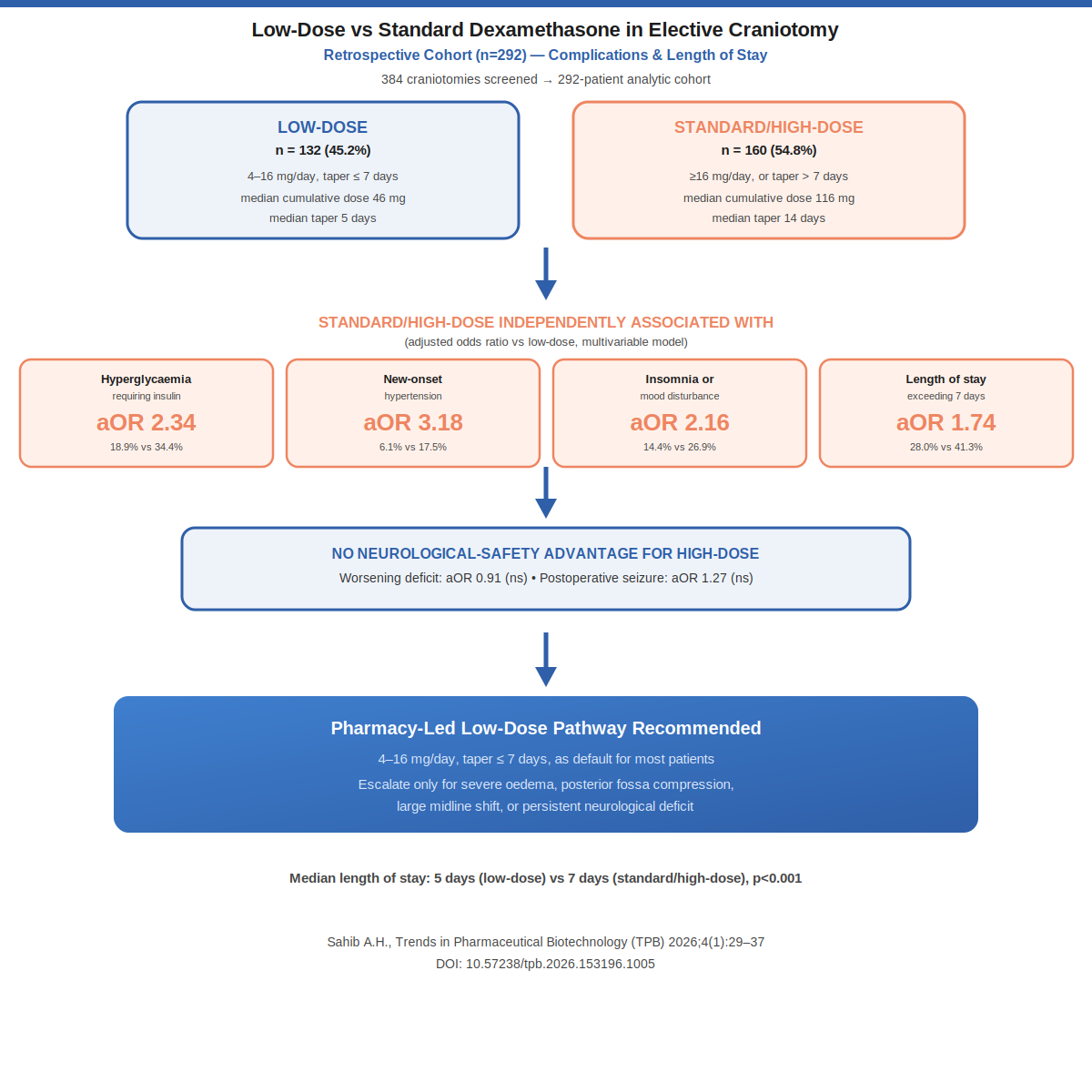
Background: Perioperative dexamethasone is administered to most patients undergoing elective craniotomy for brain tumour to reduce peritumoural oedema and postoperative neurological deterioration. Optimal dose and taper duration remain unsettled. A 2024 randomized feasibility study suggested low-dose dexamethasone is safe and tolerable in selected patients, and a reduced-exogenous-steroid-taper case-control study found significantly less new-onset hypertension with a lower cumulative dose. Locally calibrated single-centre comparative data are needed to inform pharmacy and neurosurgical pathways. Objective: To compare postoperative complication rates, length of stay (LOS), and 30-day readmission between adults receiving low-dose versus standard/high-dose perioperative dexamethasone for elective craniotomy for brain tumour, using operative-archive findings as the reference, and to identify the dosing strategy's independent associations after multivariable adjustment. Patients and Methods: A retrospective single-centre observational cohort study was conducted at Nasiriayh teaching hospital from January 2024 through December 2025 and reported in accordance with the Strengthening the Reporting of Observational Studies in Epidemiology (STROBE) statement. Adults aged 18 years or older undergoing elective craniotomy for primary or metastatic brain tumour with a documented perioperative dexamethasone regimen were included. Patients were classified as receiving low-dose (4–16 mg/day, taper ≤ 7 days) or standard/high-dose (≥ 16 mg/day or taper > 7 days) per institutional pharmacy records. Multivariable logistic regression identified independent associations of dosing strategy with each outcome, adjusting for age, sex, World Health Organization (WHO) tumour grade, tumour location, American Society of Anesthesiologists (ASA) physical status class, and preoperative neurological deficit. Results: Of 384 craniotomies screened, 292 formed the analytic cohort: 132 low-dose (45.2%) and 160 standard/high-dose (54.8%). Standard/high-dose dexamethasone was independently associated with hyperglycaemia requiring insulin (adjusted odds ratio [aOR] 2.34, 95% confidence interval [CI] 1.42–3.84), new-onset hypertension (aOR 3.18, 95% CI 1.61–6.27), insomnia or mood disturbance (aOR 2.16, 95% CI 1.25–3.74), and LOS exceeding 7 days (aOR 1.74, 95% CI 1.03–2.94). No significant differences were found for postoperative seizure or worsening neurological deficit. Conclusions: Standard/high-dose dexamethasone was associated with materially higher metabolic and psychiatric complication rates and a longer LOS than a low-dose regimen, without an apparent neurological-safety advantage. The findings support a pharmacy-led pathway to reduce default dexamethasone exposure in elective tumour craniotomy.
Keywords
Article Details
Copyright (c) 2026 Amjed Hassan Sahib (Author)

This work is licensed under a Creative Commons Attribution 4.0 International License.