

Article Sidebar
Main Article Content
Abstract
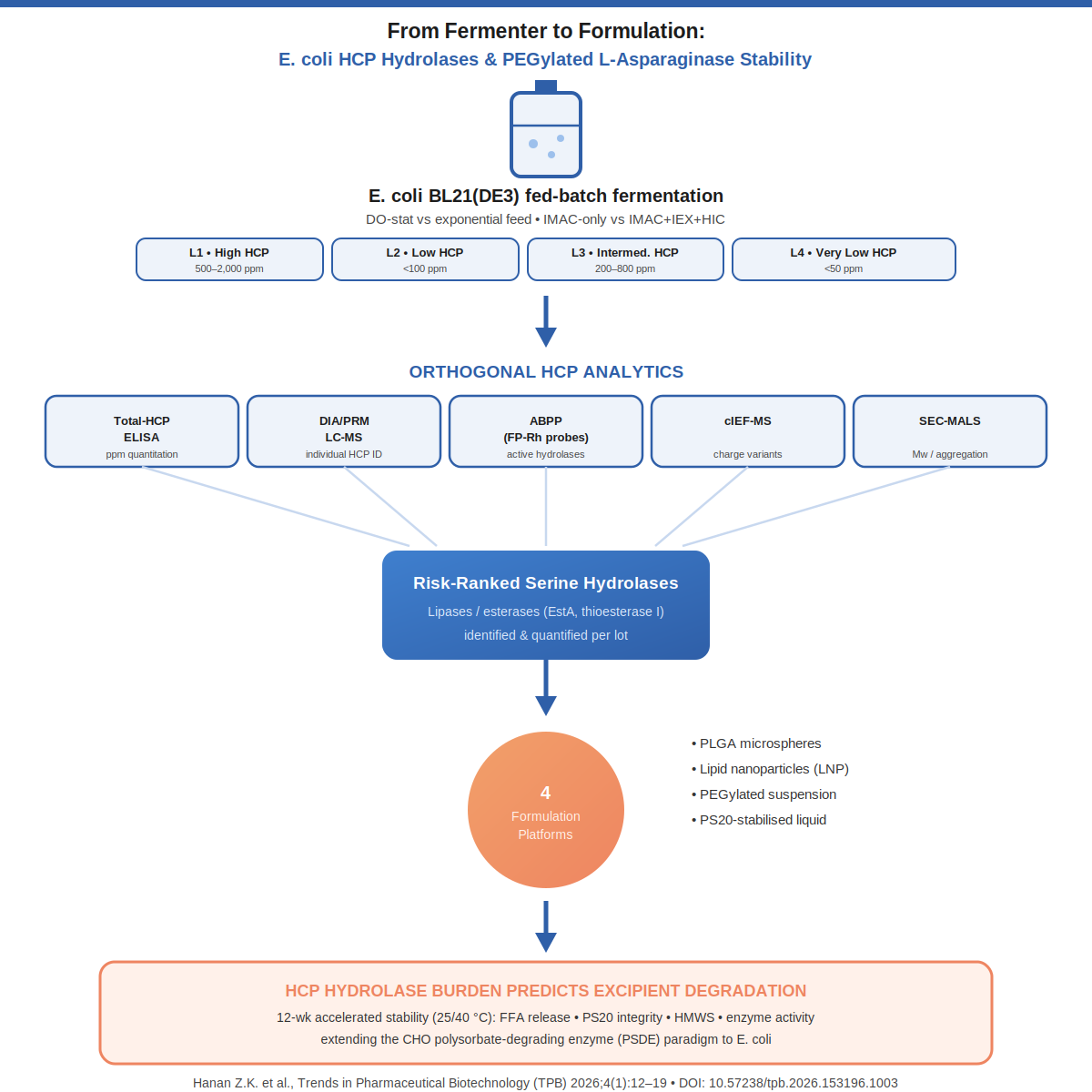
Background: Residual host cell proteins (HCPs) co-purifying with recombinant therapeutic proteins are well-characterised immunogenicity and safety liabilities; however, their role as active enzymes capable of degrading formulation excipients polysorbates, lipids, and polyethylene glycol (PEG) has been studied exclusively in Chinese hamster ovary (CHO)-derived biologics. Whether analogous lipolytic HCPs from Escherichia coli manufacturing strains contribute to excipient and protein instability in finished E. coli-derived products is unknown.Objectives: This study aims to : (i) optimise fed-batch fermentation and inclusion-body (IB) refolding of recombinant L-asparaginase (L-ASNase) in E. coli BL21(DE3) to generate drug-substance lots with deliberately varied residual-HCP profiles; (ii) apply an orthogonal purity analytics platform ELISA, DIA/PRM LC-MS, activity-based protein profiling (ABPP), cIEF-MS, and SEC-MALS to identify and risk-rank residual E. coli serine hydrolases; and (iii) determine whether residual-HCP hydrolase burden predicts polysorbate, lipid, and PEG excipient degradation and protein stability loss in PLGA microsphere, LNP, PEGylated, and polysorbate-stabilised liquid formulations under accelerated stability conditions. Methods: Four L-ASNase lots (L1–L4) will be produced by varying DO-stat versus exponential fed-batch feeding and applying two levels of downstream polish (Protocol A: IMAC only; Protocol B: IMAC+IEX+HIC), yielding lots with ≥2-fold differences in residual-HCP burden. Each lot will be characterised by total-HCP ELISA, DIA/PRM LC-MS with a novel in-house E. coli BLR/HMS174 spectral library, ABPP with fluorophosphonate–rhodamine (FP-Rh) probes, cIEF-MS, and SEC-MALS. Lots will be formulated into PLGA microspheres, LNPs, PEGylated suspension, and PS20-stabilised liquid. Accelerated stability (25 °C and 40 °C, 12 weeks) will track FFA release by LC-MS/MS, PS20 integrity by RP-HPLC-CAD, aggregation by SEC-MALS, and enzyme-activity retention by Nessler assay. Expected Outcomes: We expect to demonstrate, for the first time, that E. coli-derived residual HCP hydrolases accelerate polysorbate and lipid excipient degradation in a burden-dependent manner analogous to the CHO polysorbate-degrading enzyme (PSDE) phenomenon, thereby linking upstream bioprocessing decisions directly to final-product shelf life.
Keywords
Article Details
Copyright (c) 2026 Zaman Kareem Hanan, Adnan Abed Azeez Alazraqi, Ögret. Üyesi Aysel SARİ, Aliaa Kareem Hanan (Author)

This work is licensed under a Creative Commons Attribution 4.0 International License.